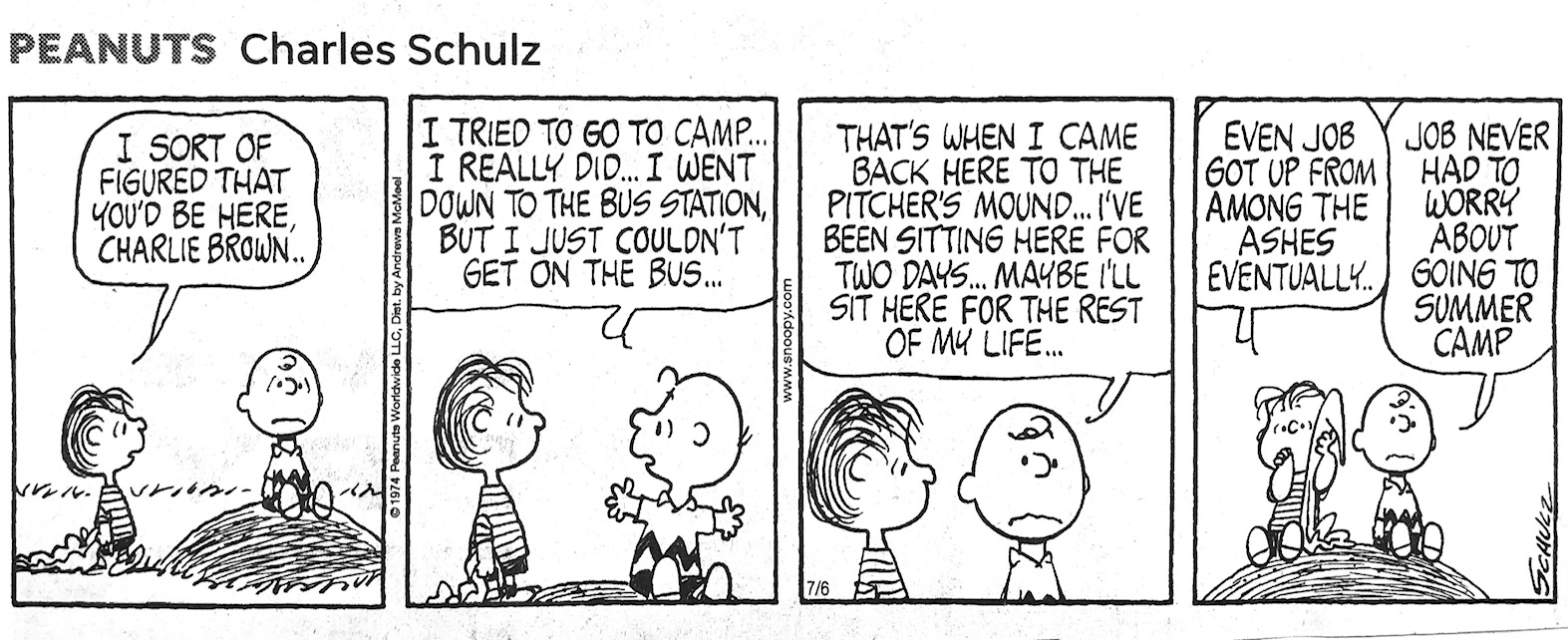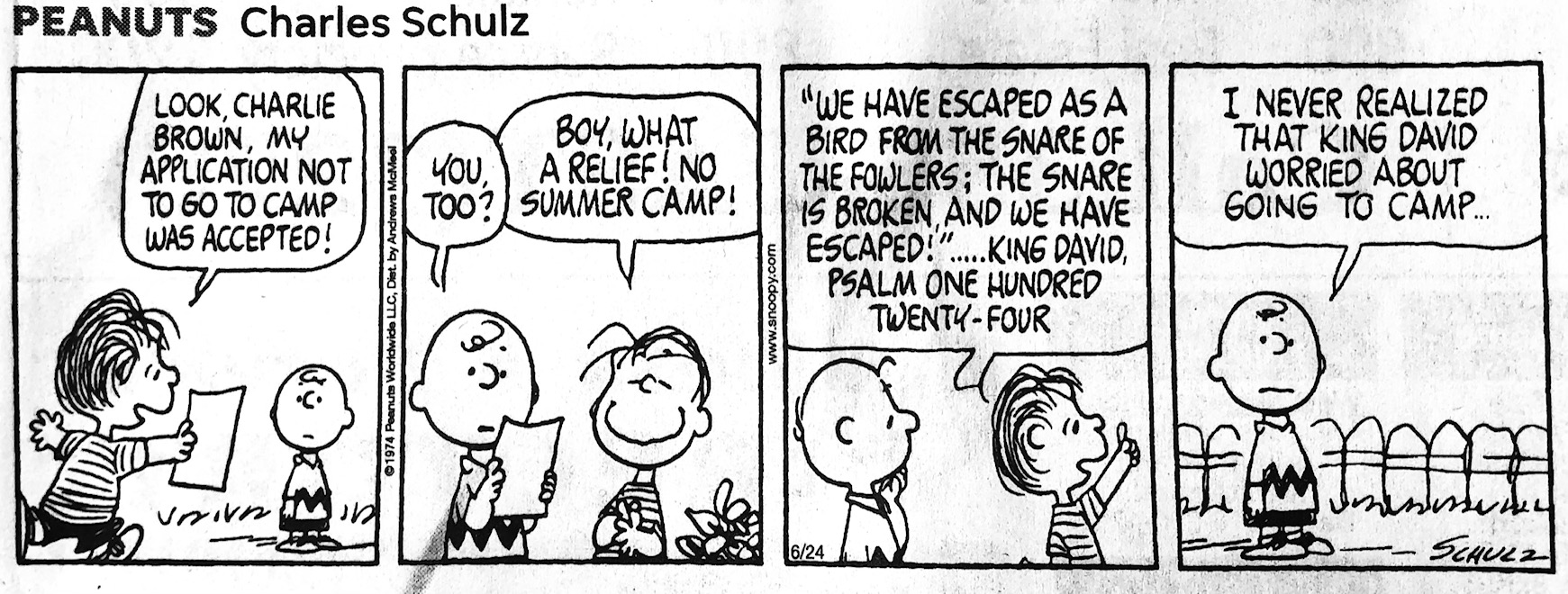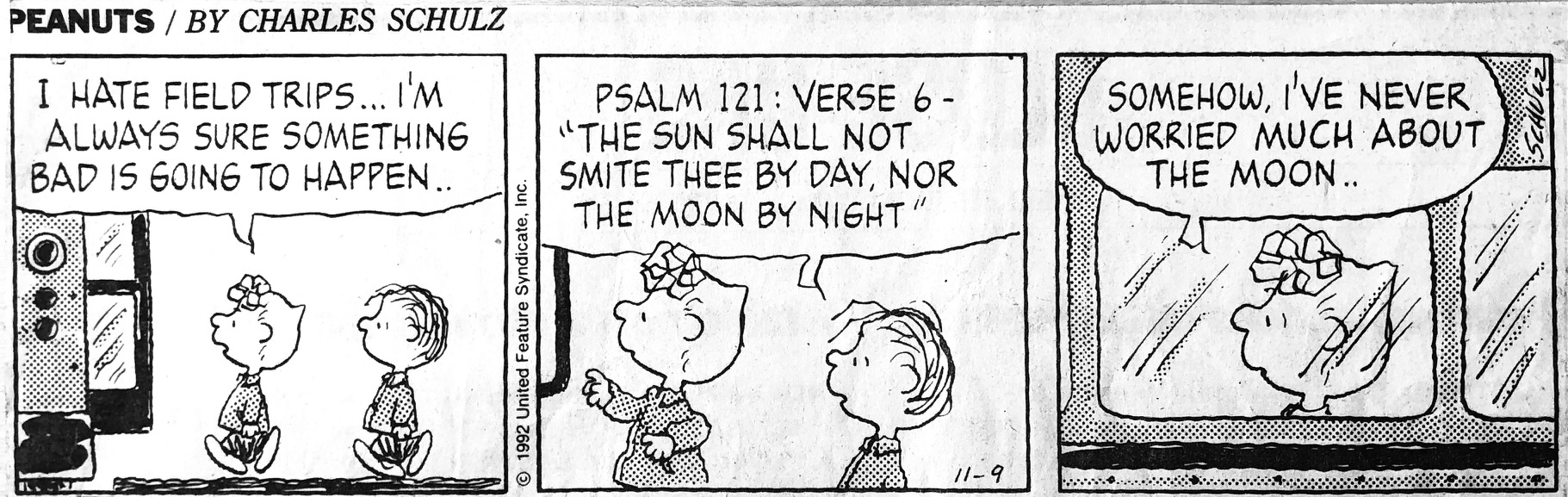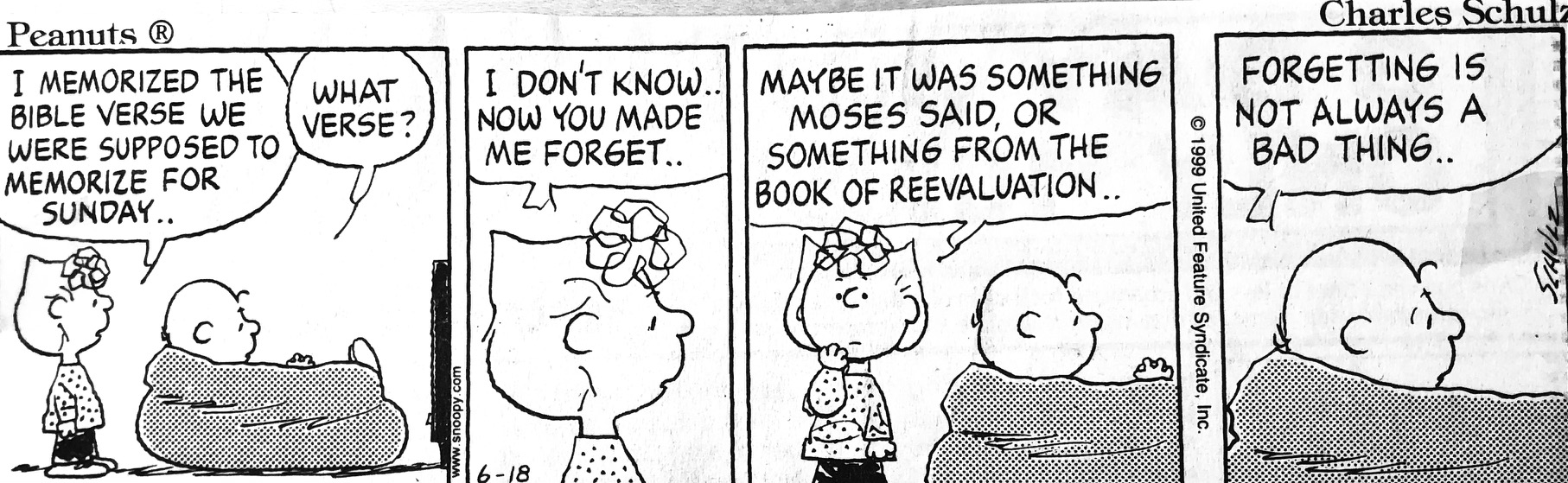
Vacation Bible Peanuts #8

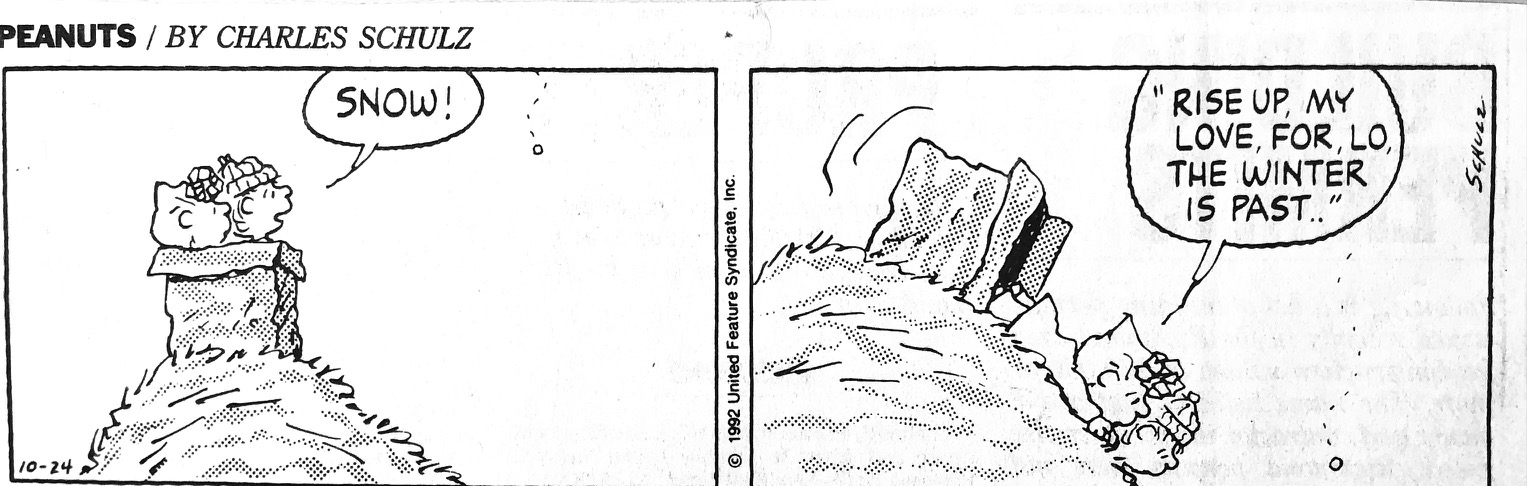
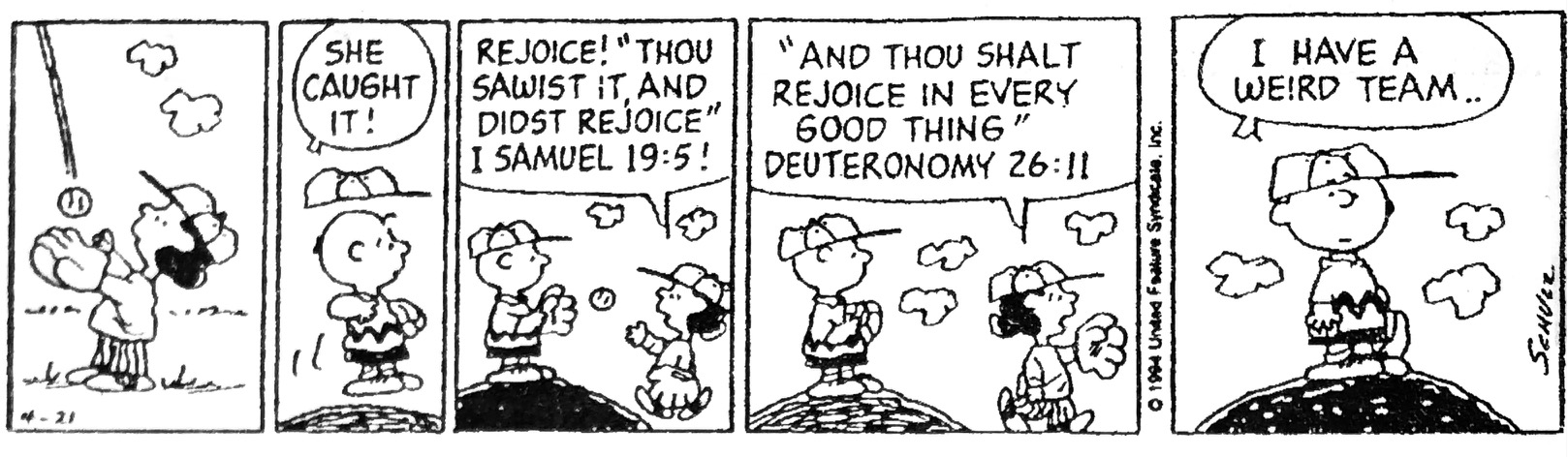
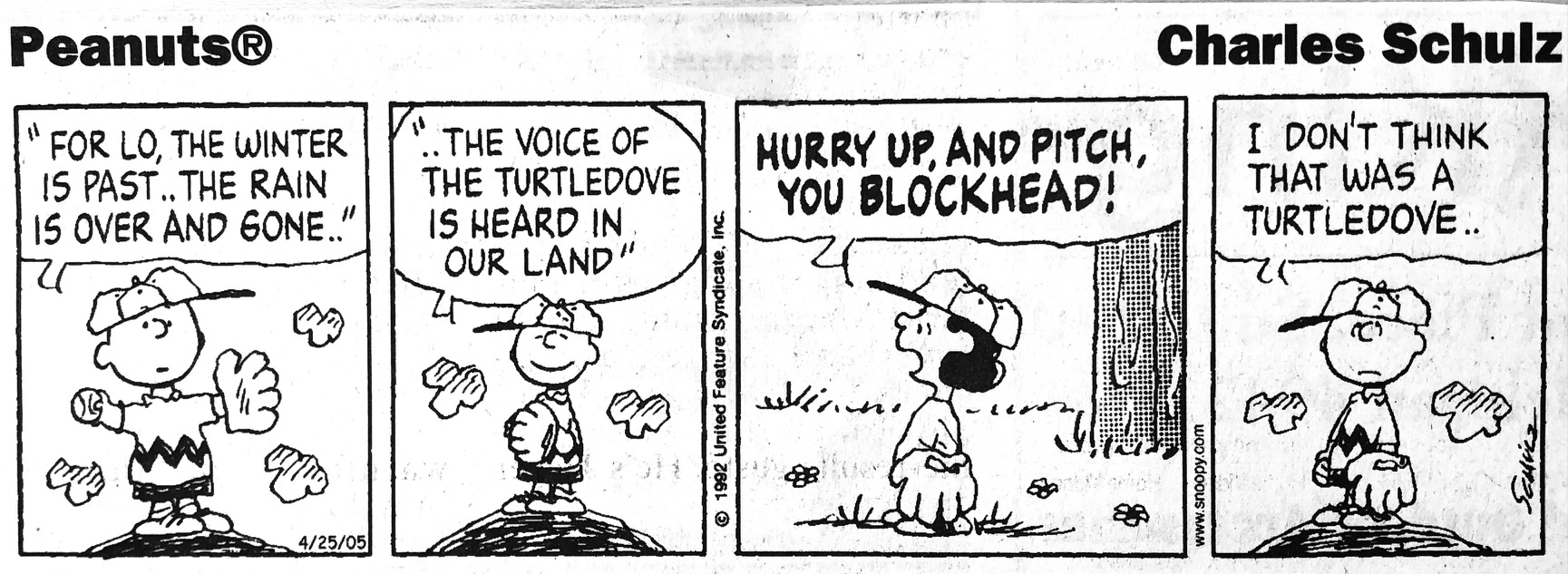
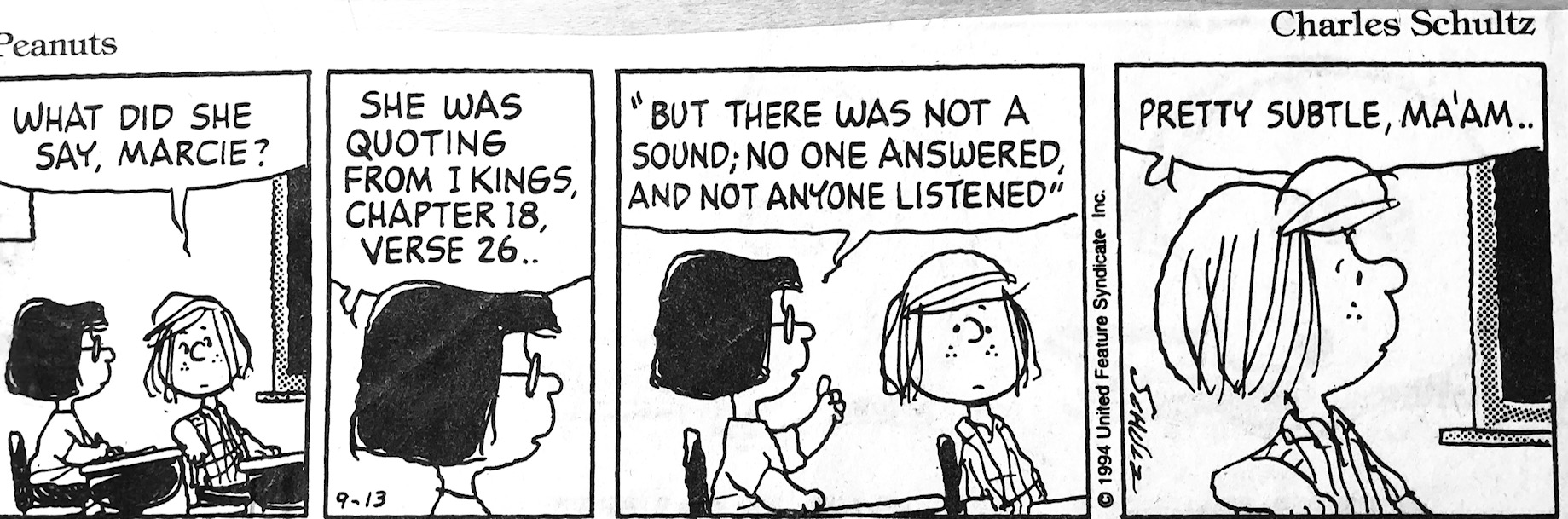
I have been a fan of Charles Schulz’ Peanuts comic strip my whole life. If you’re a fan, too, you’ll know how often the strip includes quotations from the Bible. Over the next several weeks I’ll be sharing some of my favorites.

I’m calling this series the “Vacation Bible Peanuts” because it’s high time I took a vacation. I’ve been posting a weekly Bible study blog since the end of 2017. That’s 183 blogs and counting! I’ll be back with more reflections in September. In the mean time, enjoy the Bible through the eyes of Peanuts.

Carol M. Bechtel


Fair Use Copyright Disclaimer:

This site contains copyrighted content not authorized for use by the owner, but its use falls under the guidelines of fair use (see Section 107 of the Copyright Act). The nature of this use is solely for non-profit educational purposes.

Vacation Bible Peanuts #7

I have been a fan of Charles Schulz’ Peanuts comic strip my whole life. If you’re a fan, too, you’ll know how often the strip includes quotations from the Bible. Over the next several weeks I’ll be sharing some of my favorites.

I’m calling this series the “Vacation Bible Peanuts” because it’s high time I took a vacation. I’ve been posting a weekly Bible study blog since the end of 2017. That’s 183 blogs and counting! I’ll be back with more reflections in September. In the mean time, enjoy the Bible through the eyes of Peanuts.

Carol M. Bechtel


Fair Use Copyright Disclaimer:

This site contains copyrighted content not authorized for use by the owner, but its use falls under the guidelines of fair use (see Section 107 of the Copyright Act). The nature of this use is solely for non-profit educational purposes.

Vacation Bible Peanuts #6

I have been a fan of Charles Schulz’ Peanuts comic strip my whole life. If you’re a fan, too, you’ll know how often the strip includes quotations from the Bible. Over the next several weeks I’ll be sharing some of my favorites.

I’m calling this series the “Vacation Bible Peanuts” because it’s high time I took a vacation. I’ve been posting a weekly Bible study blog since the end of 2017. That’s 183 blogs and counting! I’ll be back with more reflections in September. In the mean time, enjoy the Bible through the eyes of Peanuts.

Carol M. Bechtel


Fair Use Copyright Disclaimer:

This site contains copyrighted content not authorized for use by the owner, but its use falls under the guidelines of fair use (see Section 107 of the Copyright Act). The nature of this use is solely for non-profit educational purposes.

Vacation Bible Peanuts #5

I have been a fan of Charles Schulz’ Peanuts comic strip my whole life. If you’re a fan, too, you’ll know how often the strip includes quotations from the Bible. Over the next several weeks I’ll be sharing some of my favorites.

I’m calling this series the “Vacation Bible Peanuts” because it’s high time I took a vacation. I’ve been posting a weekly Bible study blog since the end of 2017. That’s 183 blogs and counting! I’ll be back with more reflections in September. In the mean time, enjoy the Bible through the eyes of Peanuts.

Carol M. Bechtel


Fair Use Copyright Disclaimer:

This site contains copyrighted content not authorized for use by the owner, but its use falls under the guidelines of fair use (see Section 107 of the Copyright Act). The nature of this use is solely for non-profit educational purposes.

Vacation Bible Peanuts #4

I have been a fan of Charles Schulz’ Peanuts comic strip my whole life. If you’re a fan, too, you’ll know how often the strip includes quotations from the Bible. Over the next several weeks I’ll be sharing some of my favorites.

I’m calling this series the “Vacation Bible Peanuts” because it’s high time I took a vacation. I’ve been posting a weekly Bible study blog since the end of 2017. That’s 183 blogs and counting! I’ll be back with more reflections in September. In the mean time, enjoy the Bible through the eyes of Peanuts.

Carol M. Bechtel


Fair Use Copyright Disclaimer:

This site contains copyrighted content not authorized for use by the owner, but its use falls under the guidelines of fair use (see Section 107 of the Copyright Act). The nature of this use is solely for non-profit educational purposes.

Vacation Bible Peanuts #3

I have been a fan of Charles Schulz’ Peanuts comic strip my whole life. If you’re a fan, too, you’ll know how often the strip includes quotations from the Bible. Over the next several weeks I’ll be sharing some of my favorites.

I’m calling this series the “Vacation Bible Peanuts” because it’s high time I took a vacation. I’ve been posting a weekly Bible study blog since the end of 2017. That’s 183 blogs and counting! I’ll be back with more reflections in September. In the mean time, enjoy the Bible through the eyes of Peanuts.

Carol M. Bechtel


Fair Use Copyright Disclaimer:

This site contains copyrighted content not authorized for use by the owner, but its use falls under the guidelines of fair use (see Section 107 of the Copyright Act). The nature of this use is solely for non-profit educational purposes.

Vacation Bible Peanuts #2

I have been a fan of Charles Schulz’ Peanuts comic strip my whole life. If you’re a fan, too, you’ll know how often the strip includes quotations from the Bible. Over the next several weeks I’ll be sharing some of my favorites.

I’m calling this series the “Vacation Bible Peanuts” because it’s high time I took a vacation. I’ve been posting a weekly Bible study blog since the end of 2017. That’s 183 blogs and counting! I’ll be back with more reflections in September. In the mean time, enjoy the Bible through the eyes of Peanuts.

Carol M. Bechtel


Fair Use Copyright Disclaimer:

This site contains copyrighted content not authorized for use by the owner, but its use falls under the guidelines of fair use (see Section 107 of the Copyright Act). The nature of this use is solely for non-profit educational purposes.

Vacation Bible Peanuts #1

I have been a fan of Charles Schulz’ Peanuts comic strip my whole life. If you’re a fan, too, you’ll know how often the strip includes quotations from the Bible. Over the next several weeks I’ll be sharing some of my favorites.

I’m calling this series the “Vacation Bible Peanuts” because it’s high time I took a vacation. I’ve been posting a weekly Bible study blog since the end of 2017. That’s 183 blogs and counting! I’ll be back with more reflections in September. In the mean time, enjoy the Bible through the eyes of Peanuts.

Carol M. Bechtel


Fair Use Copyright Disclaimer:

This site contains copyrighted content not authorized for use by the owner, but its use falls under the guidelines of fair use (see Section 107 of the Copyright Act). The nature of this use is solely for non-profit educational purposes.

Justice for Job’s Wife

Read: Job 1-2

Then [Job’s] wife said to him, “Do you still persist in your integrity? Curse God, and die” (Job 2:9, NRSV).

The commentators have not been kind to Job’s wife. Augustine dubbed her, “the devil’s accomplice.” Others have suggested that she was part of Job’s “punishment.”

I think she deserves better.

Step one in rehabilitating her image is acknowledging that she has a name. Granted, we don’t know what it is, but if we’re going to honor her individuality, it won’t do to refer to her as an extension of her husband. So, for the purposes of this reflection, I’m going to suggest we call her Bracha. It means “blessing.” This may seem like an ironic choice given the fact that she’s famous for telling her husband to “curse God and die.” Nevertheless, I maintain that, on balance, she is a blessing—both to Job and to us.

You’re probably familiar with Job’s story. But you may not have thought about it from Bracha’s perspective. Let’s try.

First, there is the “horrible, no-good, very bad day” in which she and her husband lose all of their worldly goods and all ten of their children (Job 1:13-19). Then her husband is smitten with a loathsome skin disease (2:7-8). He is sitting on an ash heap scraping his sores when she famously suggests that he “curse God and die.” It’s her first and only line in 42 chapters, and under the circumstances, it makes a certain amount of sense.

But what are those circumstances—theologically speaking?

Presumably, Bracha knows that her husband is a righteous man. (Some might even say he is obsessively righteous—running around offering sacrifices on behalf of his children just in case they have sinned.) Remember that she knows nothing of the heavenly bet behind the cruel sequence of catastrophes that have consumed her family. (We’ll consider that troubling wager some other day.) Finally, she must be familiar with the popular theology which assumes that the righteous are rewarded and the wicked are punished. (This is the theology that will be articulated with such certainty by the three “friends” later in the book. Notice that she doesn’t even consider the explanation that comes so easily to them: that Job has done something to deserve this.)

Are you beginning to see things from Bracha’s perspective? Her recent experience has demonstrated that the righteous are not always rewarded. In fact, just the opposite seems to be true. In her situation, God does not seem to be playing by the rules. And if God cannot be trusted, then we may as well curse God and die.

It’s a brutal conclusion, but it’s easy to see how she comes to it. Perhaps you have come to a similar conclusion at some point—standing in a cemetery or an emergency room or a lawyer’s office.

It is not, however, the only conclusion possible under such circumstances. Job eventually discovers another possibility. It will mean letting go of tidy theological equations that oversimplify the riddle of human suffering. It will mean learning to live with uncertainty. It will mean serving God even if he can’t be sure of a reward for good behavior. But in the end, Job will decide to bless God and live.

Would Job have discovered this new version of faith on his own? Who can say? What we can say, however, is that his wife, Bracha, is the first to see what’s at stake. It’s the brutal clarity of her outburst that helps Job to see it, too. Her words propel him off the ash heap. He spends the whole rest of the book trying to prove her wrong, and that quest helps him to find a more profound faith.

That, I think, is reason enough to call her “Blessing.”

Ponder: Why do you think people have been so critical of “Bracha” over the centuries? How do you feel about her?

Pray: Help us to know how to enter the sacred space of others’ suffering. Help us to discover what it means to bless God and live.

The Power of a Single Voice

Read: 1 Kings 19

[God said to Elijah], “Go out and stand on the mountain before the LORD, for the LORD is about to pass by.” Now there was a great wind so strong that it was splitting mountains and breaking rocks in pieces before the LORD, but the LORD was not in the wind; and after the wind an earthquake, but the LORD was not in the earthquake; and after the earthquake, a fire, but the LORD was not in the fire; and after the fire a sound of sheer silence. When Elijah heard it, he wrapped his face in this mantle and went out and stood at the entrance of the cave. Then there came a voice to him that said, “What are you doing here, Elijah?” (1 Kings 19:11-14, NRSV).

Have you ever caught yourself saying, “What difference can I make? I’m just one person—one small voice.”

The story of Malala Yousafzai puts the lie to that kind of logic. As a child in Pakistan, she defied the Taliban by speaking out for women’s education. They retaliated in 2012, shooting her in the head as she returned home from school. Miraculously, she survived the attack. In 2014—at age 17—she became the youngest person ever to win the Nobel Peace Prize.

Of course, Malala’s story also illustrates how dangerous it is to speak up.

The prophet Elijah knew all about such risks. At the beginning of 1 Kings 19, Elijah is running for his life. Queen Jezebel is hot on his heels, furious over the fact that Elijah has just made an object lesson out of 450 of her favorite prophets of Baal.

We can hardly blame Elijah for being depressed. He’s been on the run for the traditional “40 days and 40 nights,” after all. And even though an angel stopped by at one point with a picnic basket, Elijah now finds himself holed up in a cave on Mt. Horeb.

That location hints that the story may be coming to a head. Horeb is another name for Sinai, so as readers, we are primed for something spectacular. Elijah, on the other hand, is only primed for more depression. When God asks what he is doing there, Elijah erupts with a series of complaints. “I have been very zealous for the LORD, the God of hosts,” he says. “For the Israelites have forsaken your covenant, thrown down your altars, and killed your prophets with the sword. I alone am left, and they are seeking my life, to take it away.”

Everything Elijah says is factually correct—as far as he knows. But people aren’t usually so blunt with the Almighty. And God could hardly fail to catch the critical subtext of Elijah’s outburst. (Why have you abandoned me?) So, when God orders Elijah out of the cave and tells him to “stand on the mountain before the LORD, for the LORD is about to pass by,” we can’t be sure whether Elijah is about to get a medal or a lightning bolt.

What he gets is an object lesson, and it defies all expectations. First there is a wind, then an earthquake, and finally, a fire. All of these things are just the kind of special effects we might expect on Mt. Sinai. But to our surprise—and probably Elijah’s—God is “not in” any of these spectacular events. God does show up, however, in what the NRSV calls “a sound of sheer silence.”

This is a translation that must be under the influence of Simon and Garfunkel, because it bears little relation to what’s in the Hebrew. Translated literally, the phrase means something more like, “the sound of a faint whisper.”

Now, ask yourself: Why might this be relevant for Elijah’s situation? Why might it be relevant to ours?

Elijah thinks he is alone. He thinks he is no more than a “faint whisper,” soon to be silenced by the powers that be. But God’s elaborate object lesson declares this perception irrelevant. God is not always in the spectacular, the impressive, and the powerful. Sometimes, God shows up in the still, small voice.

Maybe that’s the message Elijah needs to hear. Maybe that’s the message we need to hear.

Of course, if we read the rest of the story, we see that God’s point is pretty much lost on Elijah. When God repeats the “what are you doing here” question, Elijah says exactly the same thing as before. But God gives him his marching orders anyway—which, to my mind, suggests that sometimes we have to speak out even if we’re still feeling very much alone.

Who knows? Maybe when we speak out we’ll discover that we are not as alone as we thought we were. That’s what happened for Elijah (see v. 18).  But regardless, isn’t it freeing to know that God can speak through the sound of a faint whisper?

Ponder: Can you think of examples from history—or your own life—where a single voice made a huge difference? How would you answer God’s question, “What are you doing here?”

Pray: Give me the courage to use my voice for good even when I am afraid.