

Faithful Foreigners: Harbona and Company


Read: Esther 6:14-7:10

Then Harbona, one of the eunuchs in attendance on the king, said, “Look, the very gallows that Haman has prepared for Mordecai, whose word saved the king, stands at Haman’s house fifty cubits high.” And the king said, “Hang him on that” (Esther 7:9).

Nobody pays much attention to the eunuchs in the book of Esther. Just like some people don’t pay much attention to getting their oil changed until their car goes up in smoke.

Every time one turns around in the book of Esther, a eunuch is there with a quiet word that makes a positive difference. In fact, it is not an exaggeration to say that, without the eunuchs, this story would not have a happy ending.

Of course, not all of the eunuchs are admirable. A couple of them try to assassinate King Ahasuerus in chapter two. But by a stroke of luck (or providence), even their unsuccessful plot sets up a beneficial plot twist.

Which brings us to Harbona, the eunuch featured in the dramatic scene from chapter seven. We don’t know much about him, except that he is a eunuch. In the ancient world, captive men were often involuntarily castrated so that they could “safely” guard a king’s harem. This is pretty much what Harbona is doing in chapter one, when he is mentioned as one of the seven eunuchs sent to fetch Queen Vashti. Here in chapter seven, we see him in a similar role—close to both the new queen and the central action of the story.

There is no substitute for reading the whole book, of course, but even if you’ve stumbled into this story late in the game, it’s easy to feel the tension in this scene at the end of chapter seven. Haman’s plot to commit genocide has been revealed, and he attempts to save himself by throwing himself on Queen Esther’s mercy. Unfortunately for him, he also throws himself on the Queen’s couch, which is, of course, frowned upon. The king, who has been out in the garden taking a time out, comes back into the room just in time to see the incriminating tableau.

If you have read the whole story, you will know that King Ahasuerus is not the brightest light in the harbor. So as readers, we are hardly surprised when he misinterprets the situation. But since we know that Haman is guilty as sin (he was plotting genocide, after all), we hardly care if Ahasuerus condemns him for the wrong reasons.

But here is where Harbona comes in. He knows King Ahasuerus as well as anyone. And he knows that this king cannot be trusted to make good decisions. Ahasuerus always needs a nudge (if not a shove). So Harbona is there to give him one. “Oh look,” he points out casually, “that great big gallows that Haman built for the guy who saved your life is just outside the window….”

The rest, as they say, is history. Or at least, it is a crucial turning point in the story.

Harbona will never win “best supporting character in a biblical story.” I get that. But I would like to nominate him as a “faithful foreigner.” He and most of the other eunuchs in the book of Esther use their limited power to protect those who are threatened by unlimited power. Their actions make a big difference.

Maybe it’s just me, but I’m feeling like the world could use more people like Harbona and company.

Ponder:  Who are the “Harbonas” you know? What difference have they made in your life, in your community, or in the world?

Pray: When we feel powerless, remind us that your power is made perfect in weakness. Give us the wit and the courage to speak truth to power.


Introduction to the Faithful Foreigners Series

Sprinkled throughout Scripture are stories of “faithful foreigners.” These are people who are perceived as outsiders, but who often behave more faithfully than the insiders.

In our xenophobic age, it seems a good time to get reacquainted with these faithful foreigners. The Holy Spirit preserved their stories for a reason, after all. It’s my hope that we can learn some things about faith and faithfulness from what they have to teach us.

The first piece in the series explores Jesus as refugee. While it may not technically qualify as a “faithful foreigner” story, it does introduce us to some themes that will be important for understanding the faithful foreigner motif—and our resistance to those we perceive as “other.” After that, we’ll meet Rahab, Uriah, some eunuchs, a Roman centurion, and yes—even a couple of faithful foreigners from the animal kingdom!

As it happens, I am writing this series while on sabbatical in Rome, Italy. It will be interesting to see how my own experience of being a foreigner influences my engagement with these stories. You can decide if I’m a faithful foreigner or not!


Faithful Foreigners: A Fish Named Grace


Read: Jonah 1

But the LORD provided a large fish to swallow up Jonah; and Jonah was in the belly of the fish three days and three nights…Then the LORD spoke to the fish, and it spewed Jonah out upon the dry land. (Jonah 1:17 & 2:10).

It is probably safe to say that, for most of us, getting swallowed by a big fish would not be a good thing.

For Jonah, however, it was a good thing. A very good thing. Granted, it may not have been pleasant. And scrambling up onto the beach drenched in fish vomit had to be pretty undignified. But since it was that or drowning, I think one can argue he came out ahead.

The late Howard Hageman once began a lecture on the book of Jonah with the following disclaimer: “I am not going to talk about either the credibility of the story or the edibility of the prophet.”

Hageman’s instincts were spot on. Most of us get so distracted by the “incredulity quotient” in this story that we miss its most important points. So, for the duration of this reflection, I invite you to suspend disbelief and, like Jonah, simply go where the fish takes you.

The first thing to say about this fish is that she is more obedient than the prophet. Think about it. God calls Jonah to go preach repentance to the city of Nineveh. While there is a time-honored tradition of people initially resisting a call from God (think Moses and Jeremiah), Jonah doesn’t even bother to bicker with the Almighty. He just heads straight to the travel agent and buys a one-way ticket to Tarshish. God is not amused, and that’s where the fish comes in. Her obedience to God’s call is a perfect foil for the disobedient prophet she rescues.

Until we recognize the fish as an agent of God’s grace, we will never glimpse what this book is about. Consider this. Jonah is happy to accept God’s grace in the form of the fish. He even writes a psalm about it while treading water in her digestive juices. But when God grants the city of Nineveh a reprieve, Jonah storms out of town and pitches a prophetic fit. He actually has the temerity to complain about God’s being “a gracious God and merciful, slow to anger, and abounding in steadfast love” (4:2). Never mind that these words are used over and over in the Bible as a confession of faith and a reason to celebrate. Jonah can’t stand it that God has been gracious to people he doesn’t like.

It would be easier to mock Jonah for his hypocrisy if we weren’t so full of it (hypocrisy, that is) ourselves. Eager to accept God’s grace when it is offered to us, how often do we resist the idea that God might also be gracious to those we don’t approve of?

For centuries, readers have obsessed about the “credibility quotient” of this story. We have argued about whether a grown man could really be swallowed by a fish and live to tell about it. We have speculated endlessly about whether it was a fish or a whale.

Perhaps it’s time to simply admit that the fish is a “red herring”—at least in the sense that such speculations distract us from the central truth of this story. At the end of the day, this is a story about a fish named Grace. And she is one of the Bible’s best “faithful foreigners.”

Ponder:  These verses from “There’s a Wideness in God’s Mercy” by Frederick William Faber (1814-1863):

There’s a wideness in God’s mercy
like the wideness of the sea;
there’s a kindness in God’s justice
which is more than liberty.

There is no place where earth’s sorrows
are more keenly felt than heaven;
there is no place where earth’s failings
have such gracious judgement given.

For the love of God is broader
than the measure of our mind;
and the heart of the eternal
is most wonderfully kind.

Pray: Forgive us when we assume it our right to begrudge your grace to others. Make us more grateful and more generous.

Introduction to the Faithful Foreigners Series

Sprinkled throughout Scripture are stories of “faithful foreigners.” These are people who are perceived as outsiders, but who often behave more faithfully than the insiders.

In our xenophobic age, it seems a good time to get reacquainted with these faithful foreigners. The Holy Spirit preserved their stories for a reason, after all. It’s my hope that we can learn some things about faith and faithfulness from what they have to teach us.

The first piece in the series explores Jesus as refugee. While it may not technically qualify as a “faithful foreigner” story, it does introduce us to some themes that will be important for understanding the faithful foreigner motif—and our resistance to those we perceive as “other.” After that, we’ll meet Rahab, Uriah, some eunuchs, a Roman centurion, and yes—even a couple of faithful foreigners from the animal kingdom!

As it happens, I am writing this series while on sabbatical in Rome, Italy. It will be interesting to see how my own experience of being a foreigner influences my engagement with these stories. You can decide if I’m a faithful foreigner or not!

Faithful Foreigners: Rahab the Resourceful


Read: Joshua 2

Then Joshua son of Nun sent two men secretly from Shittim as spies, saying, “Go, view the land, especially Jericho.” So they went, and entered the house of a prostitute whose name was Rahab, and spent the night there (Joshua 2:1).

It’s hard to know what to do with a book that justifies genocide. That’s the interpretive hurdle that sends many modern readers of the book of Joshua back to the locker room in defeat. But while we wait there with them for wisdom, we may still be able to find some insight in one of the book’s best stories: the story of Rahab the prostitute.

It should come as no surprise that some have tried to side-step that crude label by calling her an “innkeeper.” But the Bible is blunt on this point. She’s a prostitute. Of course, she’s also a lot of other things—and that’s part of what makes her story so instructive. But let’s not get ahead of ourselves. Here is how her story begins.

Joshua and the not-so-newly-liberated people of God are on the eastern edge of the promised land. He sends two men ahead as spies, telling them to pay particular attention to the city of Jericho.

It’s a stroke of either genius or providence that the men end up at Rahab’s house. Think about it. Where else could two men from out of town go that would arouse less suspicion? But the king of Jericho is still nervous about them, so he sends orders for Rahab to hand them over.

Her response is a brilliant, bald-faced lie. Yes, they were here, she says breathlessly, but I don’t know who they are. Anyway, they left town as the gate was closing for the night. If you hurry, you just might catch them!

Meanwhile, she has hidden the men up on her roof under some flax. (Flax is used to make linen, from which we can conclude she has a sideline.) Negotiations ensue, and she emerges with a deal. She gets the spies to swear that they will spare her and her family if she helps them escape. To make a short story shorter, she does and they do.

There’s no substitute for reading the story yourself, but as you do, look for these often overlooked qualities in the woman I prefer to call, Rahab the Resourceful:

  • She is well-informed. She knows all about the exodus and what’s happened since.
  • She is a believer. “The LORD your God is indeed God in heaven above and on the earth below,” she admits in v. 11. And then she starts talking about “kindness,” which is one of God’s most important qualities. As she has been kind, so she asks them to be kind—to her and to her whole family.
  • The fact that she insists on the safety of her whole family says a lot about her. She is not just intent on saving her own skin. It’s a detail that makes me wonder if her concern for others was a driving factor in her “day job.” There’s no way to know for sure, of course, but most prostitutes are forced into what they do to survive and to help their family survive.
  • She’s got guts. Helping spies is risky business. It could well have cost her life.
  • She’s a great strategist. Notice the way she tells the men just what they need to do to get away safely.
  • She’s as good as her word. And the Israelites honor that by keeping their end of the bargain. Don’t miss the post-script to the story in Joshua 6:22-25, where the narrator sums up her story by noting that “Her family has lived in Israel ever since” (v. 25). Tradition has it that she married one of the spies.

Of course, that is not the last word on Rahab in the Bible. She shows up in both David’s and Jesus’ genealogy (see Ruth 4:18-20; 1 Chronicles 2:10-11, Matthew 1:5). She even gets a shout-out in Hebrews 11:31 and James 2:25 where she is celebrated for her faith.

So, call her Rahab the Prostitute if you must. But call her Rahab the Resourceful, Rahab the Brilliant, Rahab the Generous, Rahab the Brave, Rahab the Faithful, and Rahab the Ancestor of  David and Jesus, too. Because she is all of these things and more.

Finally, she is one of the Bible’s best Faithful Foreigners.

Ponder: What can we learn from Rahab’s story? If you could have a conversation with her, what would you want to ask her? What might she ask you?

Pray: Help us to see people for who they really are. Help us to respond to your kindness by being kind to others—even those whom society shuns.

Introduction to the Faithful Foreigners Series

Sprinkled throughout Scripture are stories of “faithful foreigners.” These are people who are perceived as outsiders, but who often behave more faithfully than the insiders.

In our xenophobic age, it seems a good time to get reacquainted with these faithful foreigners. The Holy Spirit preserved their stories for a reason, after all. It’s my hope that we can learn some things about faith and faithfulness from what they have to teach us.

The first piece in the series explores Jesus as refugee. While it may not technically qualify as a “faithful foreigner” story, it does introduce us to some themes that will be important for understanding the faithful foreigner motif—and our resistance to those we perceive as “other.” After that, we’ll meet Rahab, Uriah, some eunuchs, a Roman centurion, and yes—even a couple of faithful foreigners from the animal kingdom!

As it happens, I am writing this series while on sabbatical in Rome, Italy. It will be interesting to see how my own experience of being a foreigner influences my engagement with these stories. You can decide if I’m a faithful foreigner or not!

Faithful Foreigners: The Kindness of Strangers


Read: Acts 27:18-28:10

After we had reached safety, we then learned that the island was called Malta. The natives showed us unusual kindness. Since it had begun to rain and was cold, they kindled a fire and welcomed all of us around it” (Acts 28:1-2).

The kindness of strangers. The phrase is so familiar that we often undervalue the reality it reflects. We’re less likely to take it for granted, however, when we are the one whose life depends on it.

Perhaps that is why this story caught my attention. My husband and I are spending some time in Italy, and we have had plenty of opportunities to be grateful for the kindness of strangers. (I would give examples, but I don’t want to worry my mother.) Or maybe it’s because I have heard two sermons in one week on this passage from Acts. It’s a riveting story that features storms, shipwrecks, and the general perils of Paul. Mostly what it’s about, however, is the mercy of God made manifest in the kindness of strangers.

If you read the story, you will realize quite quickly that not all of the strangers are kind. The sailors are down-right duplicitous. First, they try to abandon ship, and then they scheme to kill the prisoners. But their evil intentions are kept in check by a sympathetic centurion named Julius who seems to take something of shine to Paul over the course of the voyage. Perhaps he is impressed that all of Paul’s predictions keep coming true. In any case, he uses his authority to shield Paul, and his good sense to get everyone safely ashore when the ship starks breaking up (27:43-44).

Both of the sermons I heard on this passage zeroed in on the phrase “unusual kindness.” It’s the way the Bible describes the welcome that the natives of Malta give to Paul and the other victims of the shipwreck. “The natives showed us unusual kindness,” the narrator writes. “Since it had begun to rain and was cold, they kindled a fire and welcomed all of us around it” (28:2).

It’s clear that the narrator is under no illusions about this welcoming committee. They seem to be a superstitious lot. First they assume Paul is a murderer and then they declare him a god. But whatever their faults, they are the only ones in the story who don’t seem to notice (or care) about the rigid power structure that has defined the passengers up to this point. Once the sailors, the soldiers, and the prisoners wash up on shore, the natives of Malta simply treat them as fellow human beings—human beings whose lives depend on the kindness of strangers.

Both of the sermons I heard were in the context of services celebrating the Week of Prayers for Christian Unity. To say that these were celebrations is perhaps a bit premature, since Christians have not been especially successful at manifesting unity—in this or in any other century. We mostly manifest things that don’t much call for celebration. So, we pray for a unity that—even on a good day—exists only in part.

But perhaps that’s why both preachers—Monsignor Juan Usma Gomez and Pope Francis—decided to stress this notion of “unusual kindness.” Would that it were not so unusual for Christians to be kind to one another and to others. Maybe that’s why the witness of these “faithful foreigners” from Malta is so powerful. What might the church look like—what might the world look like—if we could see beyond the power structures and labels we impose on each other? What would happen if we saw each other as human beings—children of God is need of unusual kindness?

Ponder: When have you experienced unusual kindness? How did it/does it shape the way you see the world?

Pray: Kind and merciful God, may others see your kindness and mercy in all we do and say. Forgive us for making the world a place where kindness is unusual.


Introduction to the Faithful Foreigners Series

Sprinkled throughout Scripture are stories of “faithful foreigners.” These are people who are perceived as outsiders, but who often behave more faithfully than the insiders.

In our xenophobic age, it seems a good time to get reacquainted with these faithful foreigners. The Holy Spirit preserved their stories for a reason, after all. It’s my hope that we can learn some things about faith and faithfulness from what they have to teach us.

The first piece in the series explores Jesus as refugee. While it may not technically qualify as a “faithful foreigner” story, it does introduce us to some themes that will be important for understanding the faithful foreigner motif—and our resistance to those we perceive as “other.” After that, we’ll meet Rahab, Uriah, some eunuchs, a Roman centurion, and yes—even a couple of faithful foreigners from the animal kingdom!

As it happens, I am writing this series while on sabbatical in Rome, Italy. It will be interesting to see how my own experience of being a foreigner influences my engagement with these stories. You can decide if I’m a faithful foreigner or not!

Faithful Foreigners: Uriah the Loyal


Read: 2 Samuel 11

Uriah said to David, “The ark and Israel and Judah remain in booths; and my lord Joab and the servants of my lord are camping in the open field; shall I then go to my house, to eat and to drink, and to lie with my wife? As you live, and as your soul lives, I will not do such a thing” (2 Samuel 11:11, NRSV).

Uriah does not get top billing in most people’s memories of 2 Samuel 11. His character gets crowded out even in the way the story is referenced. Case in point: have you ever heard this infamous chapter referred to as the story of “David, Bathsheba, and Uriah”?

In spite of this, Uriah the Hittite is arguably the most admirable character in the story. (Bathsheba gets honorable mention, in my opinion, but I will save her time in the spotlight for another day.) David, on the other hand, comes across as anything but admirable. The contrast between the two makes this a classic case of the “faithful foreigner” motif.

To summarize: While General Joab and the army are out risking life and limb, King David is back at the palace getting up to no good. While pacing on the palace roof, he plays peeping tom. Although he knows full well that the object of his admiration is “the wife of Uriah the Hittite” (v. 3), he sends the royal messengers to bring her to the palace.

I know that I promised to save Bathsheba’s time in the spotlight for another day. But an honest analysis of the story really requires that she get a “Me Too” moment. Try to see the story from her perspective. Her husband is at the front. She is taking a ritual bath in what she almost certainly assumes is the privacy of her own courtyard. The next thing she knows, the palace guards are at the gate. What would you think? Maybe there is news of Uriah. In any case, she has no choice but to go with them. What happens after than says much more about David than it does about Bathsheba. The poor woman barely even gets an active verb until she sends to David and tells him she is pregnant. Since the punishment for “adultery” is stoning, we can hardly blame her for that. She is literally between a rock and a hard place. If you doubt her innocence, read ahead to the prophet Nathan’s parable in 2 Samuel 12. Bathsheba deserves no more blame than the “little ewe lamb.”

I suppose we ought to give David some credit for responding to her message, although the response itself does not cover him in glory. After three failed attempts to get Uriah to sleep with Bathsheba—and thus solve the paternity problem—David finally sends word to Joab to get Uriah killed. In what is the story’s most poignant bits of irony, David entrusts the murderous message to Uriah himself. David knows he won’t open it. Uriah is the epitome of a straight arrow, after all. Unfortunately, he ends up on the receiving end of the same.

Why won’t Uriah “go down to his house”? There must be some reason he disobeys a direct order from his commander in chief.

If you take Hollywood’s word for it, Uriah is a prig and a fanatic. But perhaps we shouldn’t look to that 1951 film starring Gregory Peck and Susan Hayward for excellence in exegesis. The truth is that Uriah—even though he is a foreigner—is abiding by the law that prohibits soldiers from sexual intercourse before a battle. The fact that King David urges him to violate that law—three times, no less—says a great deal about where David’s loyalties lie.

There is an annual insurrection in my Old Testament class over what some students see as my “disrespect” for David. My plea to them—and to you, dear readers—is to get David down out of the stained glass window. The Bible does not whitewash this story, and neither should we. Second Samuel’s David is deeply flawed. Uriah the Hittite—or perhaps we should call him Uriah the Loyal—is the foil that helps us see David’s sins.

Ponder: Why do you think this story is included in the Bible? What are we meant to learn from it? What do we lose when we participate in a cover-up? What can we learn from Uriah’s loyalty?

Pray: Gracious God, our sins are ever before us (Psalm 51). Help us to be honest about all the ways we have failed you. Thank you for your forgiveness, and for being willing to work through imperfect people. Give us leaders who put the welfare of others before their own selfish desires.


Introduction to the Faithful Foreigners Series

Sprinkled throughout Scripture are stories of “faithful foreigners.” These are people who are perceived as outsiders, but who often behave more faithfully than the insiders.

In our xenophobic age, it seems a good time to get reacquainted with these faithful foreigners. The Holy Spirit preserved their stories for a reason, after all. It’s my hope that we can learn some things about faith and faithfulness from what they have to teach us.

The first piece in the series explores Jesus as refugee. While it may not technically qualify as a “faithful foreigner” story, it does introduce us to some themes that will be important for understanding the faithful foreigner motif—and our resistance to those we perceive as “other.” After that, we’ll meet Rahab, Uriah, some eunuchs, a Roman centurion, and yes—even a couple of faithful foreigners from the animal kingdom!

As it happens, I am writing this series while on sabbatical in Rome, Italy. It will be interesting to see how my own experience of being a foreigner influences my engagement with these stories. You can decide if I’m a faithful foreigner or not!
Faithful Foreigners: Balaam’s Ass


Read: Numbers 22:22-35

Then the LORD opened the mouth of the donkey, and it said to Balaam, “What have I done to you, that you have struck me these three times?” (Numbers 22:28, NRSV).

If you have ever learned a language, you know that one usually starts with the typical before moving to the exceptional. You learn the pattern of the regular verb first. Once you’ve got it down cold, then you venture on to the irregular ones—albeit with fear and trembling.

The wisdom of this approach is fresh in my mind because my husband and I are trying to learn Italian. We have a very healthy fear of irregular verbs. So, I know that it might be better to begin this series on “faithful foreigners” by establishing the regular pattern: someone who is perceived to be a “foreigner” proves to be wise, faithful, and ultimately important to the story the Bible is trying to tell. However, this time the exceptional is so exceptional, we’re going to start there and save the typical for later.

I’m talking about Balaam’s ass. She is not just a faithful foreigner; she is a cross-species faithful foreigner. I love her not just because she makes her owner look like an ass, but because she has some choice words for us as well. And if we can suspend disbelief long enough to listen to her, we might find ourselves wiser for it.

Balaam is himself a foreigner, but he is only faithful about 85% of the time. (He gets a B as compared to his donkey’s A+.) He has been conscripted by the king of Moab to curse the newly liberated people of God, who have come up from Egypt and are encroaching on his territory (vv. 4-6). Balaam has some scruples, however, and refuses to curse what he knows God has blessed. He only agrees to go with the king’s emissaries after getting special permission from God (v. 20), and makes no promises at that. He saddles his infamous ass, and sets out.

It’s unclear why “God’s anger was kindled because he was going,” but in any case, “the angel of the LORD took his stand in the road as [Balaam’s] adversary” (v. 22).

This is when the fun begins.

Even though Balaam is, by profession, a “seer,” he is completely blind to the fact that the angel of the LORD is “standing in the road with a drawn sword in his hand” (v. 23). The donkey’s eyes are just fine, however, and she wisely turns off the road. Balaam beats her for her trouble, and forces her back on the road.

The next time the angel appears it is smack in the middle of a narrow path between the walls of two vineyards. What’s a poor donkey to do? She thinks fast, and scrapes Balaam’s foot against the wall. The unappreciative Balaam beats her again.

The next time the angel blocks the way, the donkey simply sits down. When Balaam strikes her again, it proves too much for her—and for God. God opens her mouth and she asks Balaam point blank, “What have I done to you that you have struck me these three times?”

Balaam’s response says more about him than it does about her: “Because you have made a fool of me! I wish I had a sword in my hand! I would kill you right now!”

His ingratitude must have been galling. With admirable self-control, she asks, “Am I not your donkey, which you have ridden all your life to this day? Have I been in the habit of treating you this way?” Even Balaam has to admit that she has not.

One wonders if it ever occurred to Balaam to ask—not just why his faithful donkey had suddenly undergone a personality transplant—but why she was suddenly speaking her mind. Perhaps it was because he was so caught up in his own righteous indignation.

There is a lesson in that for all of us when we think we are on a mission from God. We don’t always see as clearly as we think we do—even if we are professional “seers”. Wisdom is where we find it—even when it comes from unexpected sources.

Ponder: How might this story relate to issues in your life or our world? (One example might be climate change.) Whose/what voices do we need to hear? What might they be saying to us?

Pray: Give us eyes to see, O God, and ears to hear your wisdom from unexpected sources.


Introduction to the Faithful Foreigners Series

Sprinkled throughout Scripture are stories of “faithful foreigners.” These are people who are perceived as outsiders, but who often behave more faithfully than the insiders.

In our xenophobic age, it seems a good time to get reacquainted with these faithful foreigners. The Holy Spirit preserved their stories for a reason, after all. It’s my hope that we can learn some things about faith and faithfulness from what they have to teach us.

The first piece in the series explores Jesus as refugee. While it may not technically qualify as a “faithful foreigner” story, it does introduce us to some themes that will be important for understanding the faithful foreigner motif—and our resistance to those we perceive as “other.” After that, we’ll meet Rahab, Uriah, some eunuchs, a Roman centurion, and yes—even a couple of faithful foreigners from the animal kingdom!

As it happens, I am writing this series while on sabbatical in Rome, Italy. It will be interesting to see how my own experience of being a foreigner influences my engagement with these stories. You can decide if I’m a faithful foreigner or not!

Faithful Foreigners: Jesus the Refugee

Introduction to the Faithful Foreigners Series

Sprinkled throughout Scripture are stories of “faithful foreigners.” These are people who are perceived as outsiders, but who often behave more faithfully than the insiders.

In our xenophobic age, it seems a good time to get reacquainted with these faithful foreigners. The Holy Spirit preserved their stories for a reason, after all. It’s my hope that we can learn some things about faith and faithfulness from what they have to teach us.

The first piece in the series explores Jesus as refugee. While it may not technically qualify as a “faithful foreigner” story, it does introduce us to some themes that will be important for understanding the faithful foreigner motif—and our resistance to those we perceive as “other.” After that, we’ll meet Rahab, Uriah, some eunuchs, a Roman centurion, and yes—even a couple of faithful foreigners from the animal kingdom!

As it happens, I am writing this series while on sabbatical in Rome, Italy. It will be interesting to see how my own experience of being a foreigner influences my engagement with these stories. You can decide if I’m a faithful foreigner or not!

 

Jesus the Refugee


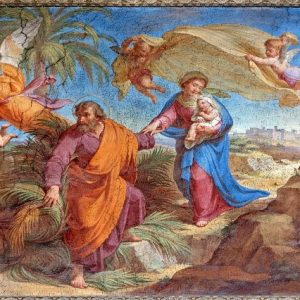
Flight to Egypt fresco by Renáta Sedmáková


Read: Matthew 2:13-23

Then Joseph got up, took the child and his mother by night, and went to Egypt (Matthew 2:14, NRSV).

A refugee is typically understood to be “a person who has been forced to leave their country in order to escape war, persecution, or natural disaster.”

The gospel of Matthew makes it crystal clear that Jesus and his parents were refugees. In this, alas, they were not and are not unusual. According to the UN Refugee Agency (UNHCR) there are currently 25.9 million refugees—the highest number ever seen. And this doesn’t even count the 41.3 million “internally displaced” individuals, or the 3.5 million “asylum-seekers” (UN Refugee Statistics). That the danger was real for Jesus and his family is borne out by Herod’s slaughter of the innocents (Mt. 2:16).

There are unusual features to the holy family’s story, of course. Joseph learns of the danger when he is tipped off in a dream by an angel. And Matthew goes out of his way to point out that this whole episode fulfills something the prophet Hosea once said (Hosea 11:1). But we shouldn’t let the extraordinary features of this story eclipse its brutally ordinary basics. Jesus and his family fled for their lives, and in doing so, they made common cause with millions of people, past and present.

So, why did presidential candidate, Pete Buttigieg, catch flack from religious conservatives when he referred to Jesus as a refugee? His Christmas tweet was straightforward:

Today I join millions around the world in celebrating the arrival of divinity on earth, who

came into this world not in riches but in poverty, not as a citizen but as a refugee.

No matter where or how we celebrate, merry Christmas.

Yet, this response by JD Rucker was typical of the push-back Buttigieg received from the Twitter-sphere:

Jesus was not born into suffering. His earthly family was neither poor nor refugees. His story

is not a metaphor to push open borders policies here and around the world. It’s a guide for life

and death, a message of hope beyond this world.

I will leave it to others to analyze all the aspects of this Christmas kerfuffle. But as we begin a new series called “Faithful Foreigners,” it seems important to point out a couple of things this story brings to the surface.

First, why are we so worried about stating the obvious? Jesus and his family were refugees. Are we so xenophobic that we cannot even contemplate the fact that Jesus had something in common with “those people?” Or perhaps it’s our discomfort with a vulnerable Savior. If that’s the case, then the cross is going to present a problem. In any case, my colleague Suzanne McDonald observed that, “If you can’t accept that they were refugees, then you have a political issue that has become a gospel problem.”

The second thing that’s worth saying is this idea that Jesus’ story is “a guide for life and death, a message of hope beyond this world.” Yes and no. Of course Jesus’ story has life and death implications. But if we think it is only—or even mostly—about the next world, then “it’s time we rubbed our eyes and read our texts again” (NT Wright in Surprised by Hope).

Pray: For all the ways we fail to see you in the faces of “those people,” dear Lord, forgive us.

Tuned for Praise: Jesus Christ the Apple Tree


Read:

As an apple tree among the trees of the wood, so is my beloved among young men. With great delight I sat in his shadow, and his fruit was sweet to my taste (Song of Solomon 2:3, NRSV).

Metaphors allow us to say what we mean—only more so.

Think for a moment about how metaphors work. They allow us to free associate. They invite us to bring memory and senses to the aid of what is often an abrupt comparison. So, when the psalmist says, “I am a worm,” everything we have ever thought or felt about worms rushes in to help us understand what the psalmist is saying (Ps. 22:6). Sure, he could have explained that he was feeling vulnerable and was having trouble reaching his full human potential. But that would have been boring. And at the end of the day, it wouldn’t have told us a fraction of what he managed to convey when he smashed the words “I” and “worm” together.

Lovers have long been quick to catch on to the potential of metaphors. In this verse from one of the world’s most famous love poems (Song of Solomon 2:3), the woman invites us to share her appreciation of her beloved by describing him as an apple tree. Go ahead. Accept her invitation. What do you think of when you imagine an apple tree? Shade, sweetness, nourishment…. The list is as long as your imagination and as broad as your experience.

It’s not clear whether this verse from the Song of Songs inspired the 18th century poem, “Jesus Christ the Apple Tree.” Others have made the leap between that ancient love song and the love between Christ and the Church. What is clear, however, is the poets’ mutual appreciation of a metaphor.

As you read it—and then listen to it expressed musically—free associate. Bring your own memories to the poet’s extended metaphor. Let the richness of the comparison fill your senses and your soul. Because metaphors allow us to say what we mean—only more so.


JESUS CHRIST THE APPLE TREE

The tree of life my soul hath seen,
Laden with fruit, and always green:
The trees of nature fruitless be
Compared with Christ the apple tree.

His beauty doth all things excel:
By faith I know, but ne’er can tell
The glory which I now can see
In Jesus Christ the apple tree.

For happiness I long have sought,
And pleasure dearly I have bought:
I missed of all; but now I see
‘Tis found in Christ the apple tree.

I’m weary with my former toil,
Here I will sit and rest awhile:
Under the shadow I will be
of Jesus Christ the apple tree.

This fruit doth make my soul to thrive,
It keeps my dying faith alive;
Which makes my soul in haste to be
With Jesus Christ the apple tree.


Listen:  Jesus Christ the Apple Tree This anthem by Elizabeth Poston is based on a text from “Divine Hymns or Spiritual Songs” compiled by Joshua Smith in 1784. This performance is by Seraphic Fire, conducted by Patrick Dupré Quigley.

Pray: We would rest here a while, O Christ—from our toil and ambition, from our anxiety and grief. Make our soul to thrive. Keep our dying faith alive.

Introduction to the Tuned for Praise Series

Leonard Bernstein once observed that “music . . . can name the unnameable and communicate the unknowable.”

In this series, we will take advantage of music’s power to pick up where words leave off. Each Bible passage will be paired with a link to a recording that—in my judgement at least—interprets Scripture’s words in ways that words cannot.

Enjoy!

Tuned for Praise: Sore Afraid


Read: Luke 2:8-20

Then an angel of the Lord stood before them, and the glory of the Lord shone around them, and they were terrified. (Luke 2:9, NRSV).

The shepherds were right to be terrified. The glory of the Lord can get you killed.

Ask the prophet Isaiah, who sees the Lord “high and lifted up” and knows right away he has no business in the presence of such electrifying holiness. “Woe is me!” he cries in Isaiah 6.  “I am lost, for I am a man of unclean lips and I live among a people of unclean lips; yet my eyes have seen the King, the LORD of hosts!”

Moses may not know what he is getting into when he blithely says to the Almighty, “Show me your glory, I pray” (Ex. 33:18). God agrees, but only after stashing Moses in the cleft of a rock. When God passes by, Moses only gets to see God’s backside. We’re left to assume that God’s full-frontal glory would have turned Moses to cinders.

And then there is Ezekiel who is so nervous about describing God’s glory that he begins to sound like a contemporary teenager. The last three verses of Ezekiel’s call narrative contain eleven uses of the word “like” (Ez. 1:26-28). It’s just too risky to come right out and describe what God, so he settles for approximations. At the end he sums it all up with the doubly-distancing sentence: “This was the appearance of the likeness of the glory of the Lord.” Then he promptly falls on his face.

So we can hardly blame those certain poor shepherds in the gospel of Luke for being “sore afraid” (KJV) when “an angel of the Lord stood before them, and the glory of the Lord shone around them.”

One of my favorite Christmas pageant memories is of the year when my daughter (then about age 7) played an unsuspecting shepherd. This was one of those delightfully unrehearsed productions. She had been told to “do whatever the story says.” So when the angel showed up and she heard the words, “sore afraid,” she dropped to the floor and started writhing. “Well, the story did say SORE!’ she told me afterwards.

Sometimes I wish we could capture a bit more of that “sore afraid” spirit when we hear the Christmas story. It’s one of those times when familiarity breeds not so much “contempt” as “numbness.”

Maybe that’s why I’m so drawn to this poem be Jaroslav Vajda. It helps us to feel the shock waves in this story. And if we find ourselves scurrying for cover when the angel tears the sky apart with light—well—maybe that’s as it should be.


Before the Marvel of This Night


Before the marvel of this night

Adoring, fold your wings and bow,

Then tear the sky apart with light

And with your news the world endow,

Proclaim the birth of Christ and peace,

That fear and death and sorrow cease:

Sing peace, sing gift of peace!

Awake the sleeping world with song,

This is the day the Lord has made.

Assemble here, celestial throng,

In royal splendor come arrayed.

Give earth a glimpse of heav’nly bliss,

A teasing taste of what they miss:

Sing bliss, sing endless bliss!

The love that we have always known,

Our constant joy and endless light,

Now to the loveless world be shown,

Now break upon its deathly night.

Into one song compress the love,

That rules our universe above:

Sing love, sing God is love!

Text by Jaroslav Vajda


Listen:  Before the Marvel of This Night This anthem by Carol Schalk interprets a poem by  Jaroslav Vajda. This recording is by the St. Olaf Choral Ensemble.

Pray: Give us the sense to know when we are on holy ground this Christmas.


Introduction to the Tuned for Praise Series

Leonard Bernstein once observed that “music . . . can name the unnameable and communicate the unknowable.”

In this series, we will take advantage of music’s power to pick up where words leave off. Each Bible passage will be paired with a link to a recording that—in my judgement at least—interprets Scripture’s words in ways that words cannot.

Enjoy!

Tuned for Praise: Born in a Barn


Read: Luke 2:1-7

And she gave birth to her firstborn son and wrapped him in bands of cloth, and laid him in a manger, because there was no place for them in the inn (Luke 2:7, NRSV).

We’ve known since we were kids that the little Lord Jesus was asleep on the hay. And we have it on the same good authority that when the cattle started lowing, Jesus didn’t even cry.

What’s “lowing”? Why do we assume baby Jesus didn’t cry? For that matter, why do we assume there were animals present? Look closely. Luke doesn’t say a word about animals. He mentions a manger. (For non-farm folks, that’s a box for holding animal food.) Ah—so we infer the presence of animals based on the reference to the manger.

I grew up on a farm. Since the barn was one of my favorite places, I always thought Jesus showed exceptionally good sense being born in one. But I was worried about that manger thing. After all, if a cow or a donkey was used to eating out of that manger, what if they took a bite out of the baby by mistake? My mother assured me that Mary and Joseph must have made sure the animals kept their distance. “But wouldn’t the animals be mad?” I wondered. Clearly, Jesus would have to be careful. Barns were great, but even I knew you had to watch yourself.

The mere mention of a manger may be weak evidence for our elaborate nativity scenes. Still, the instinct for including the animals is a good one. They are, after all, part of the creation that Christ came to redeem. And if we take the incarnation seriously, why shouldn’t they be among the first to witness the Savior’s birth?

It turns out that the only danger in our “animal enhanced” nativity scenes may not be from the animals themselves. Rather, it stems from our own tendency to romanticize the scene. Why is that we assume that any Bible story that features animals is automatically a children’s story? (Think hard about Noah’s ark. Is there anything remotely appropriate for children in that story?) Why is it that we assume the baby Jesus didn’t cry—or have a dirty diaper for that matter? If we’re going to believe in the incarnation, let’s embrace it—not sanitize it.

As we move toward the manger this Advent, let’s stop and smell the manure. Let’s allow the baby Jesus cry for a while, for heaven’s sake. And don’t just send the kids into the manger in their shepherd costumes. Crowd in there with them. It’s a story for all of us.

Besides. Who else is going to make sure the cow doesn’t take a bite out of the baby?

Listen:  O Magnum Mysterium – This anthem by Morten Lauridsen reflects on the “great mystery” of the incarnation—animals and all. This recording is by the Nordic Chamber Choir.

Translation: O great mystery and wonderful sacrament, that beasts should see the new-born Lord lying in a manger. O blessed virgin, whose body was worthy to bear the Lord Jesus Christ. Alleluia!

Prayer: Renew our sense of wonder, O God, that “he came down to earth from heaven who is God and Lord of all; and his shelter was a stable, and his cradle was a stall.”

From “Once in Royal David’s City,” words by Cecil F. Alexander, 1848.


Introduction to the Tuned for Praise Series

Leonard Bernstein once observed that “music . . . can name the unnameable and communicate the unknowable.”

In this series, we will take advantage of music’s power to pick up where words leave off. Each Bible passage will be paired with a link to a recording that—in my judgement at least—interprets Scripture’s words in ways that words cannot.

Enjoy!