
Note to Self


Read: Genesis 8-9

“When the bow is in the clouds, I will see it and remember the everlasting covenant between God and every living creature of all flesh that is on the earth” (Genesis 9:16. NRSV).

You don’t really bond with people until you’ve gone through some stuff together.

I learned this in a big way the night our house caught fire. Lightning was the culprit, and although the structural damage was significant, all humans and animals made it to safety.

Our pastors called the next day, eager to help. They were surprised when we said, “Thanks, but we don’t really need anything. The neighbors have us covered.” And they did. From the moment the fire trucks came screaming into the neighborhood, our neighbors were on it. They took us in—pets and all—on that rainy night. But that was just the beginning. For the entire seven months that it took for our house to become habitable again, the neighbors continued to rally around us with food, friendship, and generous quantities of medicinal alcohol. My husband and I will never forget it.

So, am I glad it happened? Of course not. But it would be ungrateful not to acknowledge that the fire forged some strong and lasting friendships. We liked our neighbors before; we love them now.

The end of the Bible’s flood story bears witness to a similar transformation in God’s relationship with creation. They’ve been “through some stuff” now, and while it’s made things more complicated, there is a richness that seems to have sprung from shared pain and vulnerability.

If you doubt that God is vulnerable in this story, remember what the story’s narrator said back in Genesis 6:6 about God being “grieved to [God’s] heart” Granted, it’s a chosen vulnerability, but it is still very much evident after the flood subsides. At the end of chapter eight, the narrator gives us a glimpse of God in another vulnerable moment. After inhaling the pleasing odor of Noah’s thanksgiving sacrifice, God says “in his heart”:

I will never again curse the ground because of humankind, for the inclination of the human heart is evil from youth; nor will I ever destroy every living creature as I have done. As long as the earth endures, seedtime and harvest, cold and heat, summer and winter, day and night, shall not cease (Gen 8:21-22).

Isn’t it interesting that this poignant promise is addressed, not to Noah, but to God’s own heart? It’s as if God is writing these words on a sticky note for the fridge. Scrawled across the top is, “NOTE TO SELF.”

And did you notice that God is not naïve about the state of the human heart? One of the reasons for the flood was God’s recognition that “every inclination of the thoughts of their hearts was only evil continually” (Gen 6:5). Now, with a whole lot of flood water under the bridge, things aren’t appreciably better. Ellen Davis sums it up this way:

Instead of romantic optimism, God’s statement is one of utter realism: This is how humans are. The same ‘evil impulse’ that pained God enough to destroy the world is now the very thing that moves God to foreswear total destruction.*

Why such a difference? Who knows. Maybe it’s because they have been “through some stuff.” In any case, this is the point in the story when God sets the rainbow in the clouds “as a sign of the covenant between me and the earth” (Gen 9:13).

Rainbows are universally understood as signs of hope, love, and joy. They are surely that and more. But notice that in this passage, the rainbow is primarily a reminder from God to God. It’s another “note to self” that God makes so that the next time humans mess up (and we will), God will remember to show mercy. Here is Ellen Davis again:

The covenant with Noah is the enduring sign of God’s willingness to work with the concrete, flawed reality of human nature: “the impulse of the human heart is evil from youth onward.” The bright bow of colored light in the clouds signals God’s preference for relationship, however troubled that may be, over the more peaceful option of solitary mastery of the universe.*

As a deeply flawed human being on an increasingly precarious planet, I find that incredibly comforting.

Ponder: How do you feel about God’s “chosen vulnerability”? How does the cross fit into that habit of God’s heart?

Pray: Thank you for choosing to be in relationship with us. May these difficult times forge us into stronger relationship with you, one other, and all creation.

*Ellen F. Davis, Opening Israel’s Scriptures (New York: Oxford University Press, 2019), 24-25.
One Scary Story

Read: Genesis 6-7

The LORD saw that the wickedness of humankind was great in the earth, and that every inclination of the thoughts of their hearts was only evil continually. And the LORD was sorry that he had made humankind on the earth, and it grieved him to his heart. So the LORD said, “I will blot out from the earth the human beings I have created—people together with animals and creeping things and birds of the air, for I am sorry that I have made them.” But Noah found favor in the sight of the LORD (Genesis 6:5-8 NRSV).

Why do we assume that the story of Noah’s ark is a children’s story?

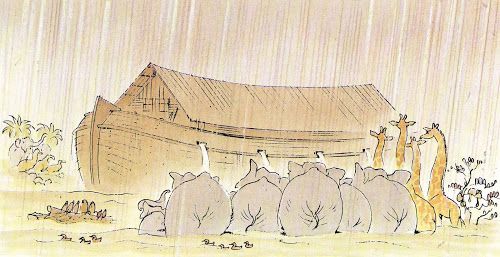
My own young daughter had what can only be described as a full-fledged freak-out when we were “reading” Peter Spier’s artistic re-telling of the ark story. She was fine until we got to the picture of the water rising on the baby elephant as it stood beside its mother outside of the ark (see above). You’ve got to admit: this is one scary story.

One of my seminary students, Michelle Wegner, admitted that she might have to reconsider reading it to her own children. Here is what she wrote in the class discussion forum:  “The cute animals, rainbow, and ark would make a very cute children’s story if it weren’t for the horror of what was happening outside the ark. I’m all for cute animals and rainbows, but I realized this week that maybe this story should be treated with a bit more sacred sorrow and awe.”

Sacred sorrow seems to be exactly what the LORD is feeling at the prospect of wiping out almost all of the earth’s living, breathing inhabitants. The story’s description of God’s being “grieved to the heart” makes it clear that this decision is not made lightly. It is portrayed as a last resort to stem the exponential spread of sin. In human terms, our grieving God just wants a do-over.

I think I felt the full force of this story for the first time when I saw a production of Benjamin Britten’s Noye’s Fludde. The one-act opera started out innocently enough. The chorus of animals marched up the aisle two by two, starting with the smallest and working back to the biggest. The audience laughed indulgently as two tiny singers dressed as gnats began the procession. And yes—they were really cute.

But then I noticed what they were singing in their little gnat voices: Kyrie, Kyrie—Kyrie eleison. Lord, have mercy. The prayer grew louder and fuller as the whole creaturely chorus filed to the front of the sanctuary and took their places in the ark.

After some brief moments of comic relief (Noah’s wife was not keen to come aboard), the mood turned deadly serious as the sky turned dark. Thunder and lightning struck fear into everyone’s hearts. Then the passengers started to sway as the ark was borne up on the storm-tossed sea. As the creatures watched the towering waves, another prayer broke out. This time it was in the form of the hymn, “Eternal Father, Strong to Save”:

Eternal Father, strong to save,

whose arm does bind the restless wave,

who bids the mighty ocean deep

its own appointed limits keep;

O hear us when we cry to Thee

for those in peril on the sea.

Perhaps it was because the audience was invited to sing along at this point, but for whatever reason, that was the moment when I understood that we are—all of us—in a state of deadly peril. Creation is again threatened, this time by human neglect, ignorance, and greed. It is a moment for sacred sorrow and awe. It is a moment for repentance, work, and prayer. It is a moment that must grieve God to the very heart.

Kyrie eleison.

Ponder: Does God’s promise in Genesis 8:21 never to “again destroy every living creature” preclude our destroying ourselves?

Pray: Lord, have mercy. You are indeed strong to save. Show us how to survive the peril of this present moment.

Watch Benjamin Britten’s Noye’s Fludde. The “Kyrie” is introduced at around minute 13; the hymn, “Eternal Father, Strong to Save” is introduced at around minute 26.

Pure Poison

Read: Genesis 4:17-26

Lamech said to his wives: “Adah and Zillah, hear my voice; you wives of Lamech, listen to what I say: I have killed a man for wounding me, a young man for striking me. If Cain is avenged sevenfold, truly Lamech seventy-sevenfold” (Genesis 4:23-24 NRSV).

I do have some sympathy for the smart aleck kid who tries to stump his Sunday School teacher with the question, “Where did Cain get his wife?” (Genesis 4:17). It’s a reasonable question. Up until this point, the Bible mentions only one nuclear family. Adam and Eve bear Cain and Abel, and Abel doesn’t last long.

So where DOES Cain get his wife?

This is one of those instances when the Bible does not seem very interested in our questions. The wife simply appears—a necessary plot device for the continuation of the story.

So what are we and the smart aleck kid supposed to do? Maybe instead of insisting that the Bible answer our questions, we might better ask, “What questions is the Bible seeking to answer in this story?”

One clue might be in the amount of real estate given to Lamech, a fifth-generation descendent of Cain, the first murderer. John Calvin describes him as “a cruel man, destitute of all humanity.” Like many cruel people, Lamech is utterly unrepentant. In fact, he brags to his two wives about his ability to avenge himself “seventy-seven fold” (v. 24).

The Bible doesn’t tell us how his wives, Adah and Zillah, responded to this boast. I suspect that his vicious nature came as no surprise. They, after all, had to live with him. One shudders to imagine what that was like.

But let’s unpack Lamech’s boast. It’s linked to the mark that God graciously puts on Cain to warn people (what people?!) from killing him. Far from being a punishment, this mark is meant to protect Cain. God cautions that “Whoever kills Cain will suffer a sevenfold vengeance” (v. 15).

Now look at the way Lamech’s boast perverts and multiplies that promise. He brags that he has “killed a man for wounding me.” Unsatisfied with “sevenfold vengeance,” he sets his sights on “seventy-sevenfold” revenge. Calvin observes:

Thus the brutality of cruel men increases in proportion as they find themselves hated; so that instead of being touched with penitence, they are ready to bury one murder under ten others. Whence it follows that they, having once become imbued with blood, shed it, and drink it, without restraint.

Earlier we asked what questions the Bible might be trying to answer by telling this story. I wonder if part of the Bible’s point has to do with the way violence—of both word and deed—seems to breed exponentially. I wish I could say I was puzzled by this point, but in truth, I think Lamech is alive and well. Think of the way hate speech has become normalized in recent years. Think of how often violent words breed equally violent actions. Such words and actions often begin with a real or perceived hurt, but indulging them is pure poison.

When we have been hurt, it is natural to want to strike back. Because this impulse is both understandable and strong, it makes it all the more important that we pause before we speak and act. To ask:

  • Is it kind?
  • Is it necessary?
  • Is it Christ-like?

Further—

  • Is there other information that might moderate my opinion?

Such considerations are not meant to silence or restrict, but only to guard against stooping to the same kind of cruelty that has caused our own suffering. We do not want to drink from the same poisonous spring.

Ponder: What tempts you to drink from the poisonous spring? How might you overcome that temptation?

Pray: From vicious words and violent actions, good Lord, deliver us.

The Predator at Our Door

Read: Genesis 4:1-16

And the LORD had regard for Abel and his offering, but for Cain and his offering he had no regard. So Cain was very angry, and his countenance fell. The LORD said to Cain, “Why are you angry, and why has your countenance fallen? If you do well, will you not be accepted? And if you do not do well, sin is lurking at the door; its desire is for you, but you must master it.” (Genesis 4:4b-7 NRSV).

Rage is all the rage these days. And goodness knows, there are plenty of legitimate reasons to be angry. Still, it feels like we have passed a tipping point somehow. It’s as if we no longer have rage; rage has us.

Ours has become a culture of outrage. I think I first became aware of this when I listened to an episode of NPR’s Hidden Brain with Shankar Vedantam. The Oct. 7, 2019 episode was called, “Screaming into the Void: How Outrage is Hijacking Our Culture and Our Minds.” It began like this:

Social media changed after the 2016 presidential election.

“I felt myself getting sucked into feedback loops where I would read something, I would feel outraged about it, [and] I would feel compelled to share it with my friends,” says Yale psychologist Molly Crockett. “I would then be sort of obsessively checking to see whether people had responded, how they had responded, you know, lather, rinse, repeat.”

Well, you know the drill. This quote highlights social media’s special “gift” for fanning the flames of our outrage. In no time at all, it consumes us and spreads to others. If we ever had control of it, we’ve lost control of it now.

The biblical story of Cain and Abel may seem pretty far removed from such realities, and yet Cain’s anger is at the heart of that first murder mystery. The only real mystery is why God rejects Cain’s offering and accepts Abel’s. Surely, it can’t just be that God prefers leg of lamb over scalloped potatoes. No, I suspect it has something to do with Cain’s attitude. Look carefully at what God asks Cain in verse seven: “If you do well, will you not be accepted?”

What might it mean for Cain to “do well” in this situation? Does God want Cain to come back with a meat entrée instead of a vegetarian entrée? No. I suspect God is encouraging Cain to take a breath—to get control of his anger. What God says next seems to confirm this. “If you do not do well,” God warns, “sin is lurking at the door; its desire is for you, but you must master it.”

What makes this metaphor even more ominous is the Hebrew behind the work “lurking.” The Hebrew verb is used not just for a predatory animal that is ready to pounce, but for a predator that has actually taken up residence. The reason it is lurking at the door is because your house has become its den!

Yikes. What was that I said a while ago about how it’s as if we don’t have rage so much as it has us?

Anger is not necessarily a bad thing. Jesus shows some healthy outrage when he overturns the tables of the moneychangers in the Temple (see Matthew 21:12-13 and Mark 11:15-17). But anger that is completely out of control is another matter entirely—even if it begins with a righteous cause. That’s the kind of anger that lurks at our door. That’s the kind of anger that moves into our house. That’s the kind of anger that will eat us for breakfast unless we—with God’s help—can master it.

The story of Cain and Abel has been much on my mind this week because I am attending a denominational synod meeting. While things have not turned murderous yet, there have been many moments when I have felt sin “lurking at the door”—especially in myself. So, I am trying to “do well.” I’m trying to take a breath—to consider my words and to examine my motivations. And I am remembering not only the story of Cain and Abel, but Paul’s words to a group of fractious Ephesian Christians:

“So then, putting away falsehood, let all of us speak the truth to our neighbors, for we are members of one another. Be angry but do not sin; do not let the sun go down on your anger, and do not make room for the devil” (Ephesians 4:25-27).

Ponder: Have you ever posted or liked an “outraged” post on social media only to discover later that you were wrong? What did that experience teach you?

Pray: Teach us how to master our anger, Lord, so that it may serve you faithfully and well.

Labor and Deliverance


Read: Genesis 3:8-24

To the woman he said, “I will greatly increase your pangs in childbearing; in pain you shall bring forth children, yet your desire shall be for your husband, and he shall rule over you” (Genesis 3:16 NRSV).

I had an epiphany about this verse while I was in labor with my first child. It came at about hour thirty-six.

I’m not complaining. (Well, maybe a little.) Up until that point, the natural child-birth classes had served me well. But at hour thirty-six when the doctor cheerfully informed me that I was four centimeters dilated (only six to go!), I began to have doubts.

My first instinct was to go home. Labor was clearly a bad idea. I was not cut out for this. Check, please.

Fortunately, God had provided me with a very special labor and delivery nurse. Her name was Martha, and not only was she qualified and compassionate, she was also the daughter of a Presbyterian minister. After discouraging me from making a break for it, she distracted me with the one subject she knew would hold my attention: the Bible.

Why, she asked casually, did God design childbirth to be so painful? Did I really think it was all due to Eve’s ill-advised conversation with a snake?

She had me. There followed a rich conversation about Genesis 3—interrupted by frequent laughter and regular contractions.

The epiphany came when we were talking about the way the story describes all the ways the natural world suffers from the “fall.” Thorns. Thistles. Pain in childbirth. That was when the epiphany happened. Oh, for dumb! I said. Nature has been affected by the fall! Suddenly I began to rethink my commitment to “natural” childbirth. Nature might not be all it’s cracked up to be.

Martha looked at me with a gleam in her eye and the hint of a smile. Would you like something to take the edge off now? she asked gently? In short—I did.

Looking back on it, I’m a bit embarrassed that it took me so long to have that epiphany. Perhaps it’s because our culture so often assumes that if something is “100% natural,” it must also be 100% good. There’s nothing like thirty-six hours of labor to raise questions about that assumption. Well, a little dose of hemlock would probably do the trick as well, though one wouldn’t have much time to benefit from that epiphany.

So many people read Genesis 3 as if it is a prescription for how God designed things to be. (“God says men should rule over women!” etc.) That assumption reads against the grain of the story itself. This is a story the ancients told because it acknowledges that this is “not the way things are supposed to be.” It is description—not prescription. Remember this the next time someone tries to hit you over the head with Genesis 3.

When we read Genesis 3 in the context of Scripture’s larger story, it’s clear that God is willing to go to great lengths to change this description. In fact, the whole plot of the Bible seems to turn on God’s efforts to deliver us from what the apostle Paul calls, “this body of death” (Rom. 7:24). Indeed, the whole creation has been “groaning in labor pains until now” as it waits for redemption (Rom. 8:22-23). It is hard labor. But if God incarnate was willing to go to the cross for such a deliverance, it seems like the least we can do is to get with God’s program.

Martha would expect nothing less.

Ponder: What part are you playing in God’s labor and deliverance plan?

Pray: Help us to work with you and not against you, O God.

Bad Logic & Good Intentions

Read: Genesis 3:1-7

So when the woman saw that the tree was good for food, and that it was a delight to the eyes, and that the tree was to be desired to make one wise, she took of its fruit and ate; and she also gave some to her husband, who was with her, and he ate (Genesis 3:6 NRSV).

The Indian poet, Rabindranath Tagore once observed that “a mind all logic is like a knife all blade; it makes the hand bleed that uses it.” Clearly, logic must be handled with caution.

If you’ve ever been on a diet, Eve’s logic will feel very familiar. “I know I shouldn’t eat this, but….” A hungry brain is a creative brain, and before we know it, we have come up with a compelling list of reasons why we should eat whatever it is that’s tempting us. In fact, it would be a shame not to eat it. Why, it’s practically our duty to eat it….  Just that quick, it’s through the lips and over the gums—look out stomach, here it comes!

It doesn’t take long to justify a bad decision, but regret sets in almost instantaneously. I’ve always found that distraction helps at this point. Why face my guilt when I can drag someone else down with me? After all, a temptation shared counts for only half the calories, right?

It’s hard to overstate the damage this story has done to women over the millennia. Perhaps it would be more precise to say that the damage has been done by bad interpretations of the story. Many commentators (mostly male) gloss over the detail about Adam being “with her.” But think about that. If he’s been sitting there listening to the whole conversation with the snake, why doesn’t he speak up?

And what about that snake? It may live in a garden, but it’s no garden variety snake. This is not to say that it is Satan. That’s an idea that was read back into the text by later interpreters. But it’s clear that this snake is a bit…special. The Bible says it is “more crafty than any other wild animal that the LORD God had made” (v. 1), but that just means we need to keep an eye on it. And then there’s the fact that it talks. The narrative itself expresses no surprise at this, however, so perhaps we should just get over ourselves on that point. (It’s a story….) Finally, given the punishment the snake receives later in the chapter (spoiler alert) it seems like this snake can walk. So, yes—it’s a very special snake.

It’s the snake that sets Eve’s unfortunate cascade of logic in motion, and it does so with an apparently innocent question. “Did God say, ‘You shall not eat from any tree in the garden’?” Right away, Eve is off balance. She jumps to God’s defense, making it clear that God has only prohibited them from eating from this one tree. But then, like an inexperienced driver whose wheel has dropped off the edge of the road, she overcorrects by adding a detail about their being forbidden even to touch it. The rest, as they say, is history. Well, maybe not history, but it is certainly a story with a lot of truth in it.

We have had a lot of years to second guess the behavior of our mythical parents, but I can’t help wondering how they would analyze ours. I suspect they would:

  • warn us about how easy it is to do the wrong thing just after we have vowed to do the right one,
  • suggest we stop wasting time worrying about who is at fault and get on with helping one another survive,
  • observe how easily logic can be manipulated to serve selfish and/or unwise ends,
  • point out how one some people’s silence and other people’s words can conspire to create catastrophe, and
  • remind us that true wisdom makes room for obedience.

The snake—if given leave to talk—would probably point out that some of the most hard-won wisdom comes when we learn from our mistakes. Then it would slither off to mess with the mind of some other unsuspecting innocent. After all, some things never change.

Ponder: What did you see in this story that you’d never noticed before? How do Adam and Eve’s imagined insights speak to your/our current situations?

Pray: From bad logic wrapped in good intentions, Good Lord, deliver us.

Serving and Keeping the Earth

Read: Genesis 2:4b-9, 15

The LORD God took the man and put him in the garden of Eden to till it and keep it (Genesis 2:15 NRSV).

Sometimes a new perspective can make a world of difference.

That was certainly the case on Christmas Eve, 1968, when astronaut William Anders snapped this iconic picture of the earth. Anders, one of the crew members of Apollo 8, was orbiting the moon at the time. The photo gave us a new sense of both the beauty and fragility of our planet. Now known as “Earthrise,” it has been called “the most influential environmental photograph ever taken.”

Genesis 2 has the power to shift our perspective on the earth as well. If we look more closely at two key words in humanity’s job description, we may never look at our life—or our planet—in quite the same way.

Shortly after the LORD God forms the first human “from the dust of the ground” (v. 7), God puts the man in the garden of Eden “to till it and keep it” (v. 15). Tilling and keeping may seem like a pretty straightforward description of a gardener’s job. If you’re reading the story in Hebrew, however, the word choices are infinitely more intriguing.

Professor Ellen Davis points out that the Hebrew words ‘avad and shamar are rarely used with reference to agriculture. Instead, they usually describe “human activity directed toward God.”* The literal translation of ‘avad is “to serve.” Shamar, on the other hand, means “to keep,” and suggests an attitude of watchful protection.

What might it mean for us to serve the earth? What might it look like for us to keep protective watch over our planet home?

In the novel, Jayber Crow, author Wendell Berry shows us what it does NOT look like. Berry introduces us a young farmer named Troy Chatham. True to his name, Troy conquers his land with the ruthless military efficiency. After every tree is bulldozed and every field lies exhausted, Troy finds himself drowning in debt with little to show for his misguided ambitions. He has destroyed himself as well as his family’s farm.

The point of this parable is to remind us of the obscenity of looking at a place and asking, “What do I need from this place?” Instead, we should be asking, “What does this place need from me?”

This is exactly the shift in perspective suggested in Genesis 2:15. To truly “serve and keep” the earth means looking at things from a completely different angle. It means asking with Wendell Berry, “What does the earth require of us if we’re going to continue to live on it?”

That shift in perspective could make a world of difference.

Ponder: What do your places need from you? What does the earth need from us? For help with these questions watch this rare interview with Wendell Berry by Bill Moyers. It’s called Wendell Berry: Poet and Prophet.

Listen/watch this recording of John Rutter’s “Look at the World” with photos from BBC Earth.

Pray: Forgive us for taking when we should be giving. Help us to know how to serve and keep this sacred planet we call home.


*Getting Involved With God: Rediscovering the Old Testament by Ellen Davis (Cambridge, MA: Cowley Publications, 2001), 192.

Made for Each Other

Read: Genesis 2:4b-25

Then the LORD God said, “It is not good that the man should be alone; I will make him a helper as his partner” (Genesis 2:18 NRSV).

You don’t hear the word “helper” much anymore. Hamburger Helper comes to mind, but a quick look at the nutrition label is enough to raise questions about how much of a “helper” that product really is. I recently praised my 3-year-old granddaughter for being a “good helper” when she showed me how she could harvest cherry tomatoes. This praise may have been premature, since she was picking the green ones, too. But she was definitely some kind of helper.

All of this is to say, we may not have much context when we come to the verse in Genesis 2 where God sets out to make the first man a “helper.” We may have a lot of assumptions, though, and these can quickly get in the way.

The first thing to notice is that God is seeking to make the man a helper “as his partner.” This sounds like a pretty egalitarian thing, so maybe we should say goodbye to any assumptions about subservience on the basis of this phrase alone. There is an even better reason to do so, however. If we look at the Hebrew word behind “helper,” we’ll find that it is often used to describe God. For instance, Psalm 30:10 says, “Hear, O LORD, and be gracious to me! O LORD, be my helper!” I think it’s safe to assume the psalmist is not suggesting that God take a subservient role!

The Genesis story goes on to describe how the LORD God creates “every animal of the field and every bird of the air” and brings them to the man. The man watches the parade and gives all the creatures a name. While some of these animals may prove to be good company, none of them really rise to the level of “a helper as his partner.” So, God puts the man into a deep sleep and creates a woman from one of his ribs. “This at last is bone of my bones and flesh of my flesh,” the man declares.

Problem solved. They live happily ever after…or at least they do until Genesis 3.

What are we to make of this ancient story?

It seems to me that it’s not so much whether this story is true as how it is true. We don’t need to believe that God literally performed surgery on a guy in a garden to get something out of the story.

If myths tell us deep truths about ourselves, our world, and our God, then part of what this story seems to be telling us is that we were made for each other. I don’t mean this in a fairy tale sense, but in the sense that we were created for relationship. I have to believe that God had more in mind than just how much work there was to be done in the garden when God observed that “it is not good that the man should be alone.” If the pandemic has taught us nothing else, it is that we need one other.

The second thing the story seems to be telling us is that relationships should be marked by equality and mutuality. If the story has been abused to read otherwise, that’s not the story’s fault. To be a “helper” is to be a partner in every sense of the word. To be a good helper is a goal—not just for my granddaughter—but for all of us.

Ponder: How should we read this story in light of what science tells us about the gender spectrum?

Pray: Help us to be good helpers in all the relationships you give us.

Story Time

Read: Genesis 1

Then God said, “Let us make humankind in our image, according to our likeness….” (Genesis 1: 26a NRSV).

Imagine for a moment that you are one of the Hebrew exiles living in Babylon in the 6th century B.C.E. Perhaps you are preparing dinner for your family when your young daughter bursts into the kitchen, full of excitement about what she learned at her local Babylonian preschool.

“We heard the BEST story today!” she announces, throwing down her back-pack and helping herself to the chocolate chip cookies on the counter. For the next several minutes—in between bites—she regales you with an action-packed tale about a Mesopotamian mother goddess who declares war on her children because they are making too much noise. Just when you’re thinking that the story has real potential as a cautionary tale, it takes a gruesome turn. The children fight back, splitting their mother in half. (OK, so now it’s a cautionary tale for mothers….) There’s more to the story—about the creation of all the elements of the world, for instance. But finally, your daughter finishes both the cookies and her story with a flourish—her eyes wide with this final detail: “Then the tears from the mother goddess’s eyes became the two great rivers—the Tigris and the Euphrates!”

“Isn’t that the COOLEST story you’ve ever heard?” she demands.

This situation calls for parental diplomacy. It’s clear that she’ll be hurt if you don’t share her enthusiasm. There are some things about the story that make sense to you, but other details don’t quite ring true. Not to mention the story’s style. Surely, the creation of the world deserves a bit more dignity.

Keeping these thoughts to yourself, you give your daughter a hug and say, “It’s a VERY COOL story, honey. Maybe after dinner I’ll tell you another story about how the world was created….”

Anachronisms aside, this made-up story about an exilic preschooler does reflect some facts—or at least some probabilities. The Hebrew exiles almost certainly learned the Babylonian version of the creation story when they were living in Babylon during the exile. The story was a thousand years old by the time they heard it, and they seem to have liked some aspects of it because the creation story we know as Genesis 1 reflects some features of the Babylonian story. The order and number of the things being created are the same. But the exiles also made some very important revisions—revisions that say a great deal about how they thought about things.

The Hebrew version has only one God, so that’s the most obvious edit. But the creation of human beings is also dramatically different. In the Babylonian creation story, Enuma Elish, human beings are created as slaves for the capricious family of gods. In Genesis 1, on the other hand, human beings are created in the image of God. That’s quite a promotion!

So much of the contemporary conversation that swirls around Genesis 1 seems to focus on whether creation occurred in six literal days. In my opinion, this obsession is unfair to the story itself. This story is not science; it is myth. Far from being false, myths are stories that testify to deep truths. We don’t have to take them literally to take them seriously.

When we put Genesis 1 beside Enuma Elish we can see some of the ways the Holy Spirit has inspired some very significant changes. The assertion that human beings are created in the image of God is one of the most important. What would it mean if we were to take that change seriously—both for how we see ourselves and for how we treat one another? What would it mean if we tried to read this ancient story on its own terms?

Ponder: How do you feel about the idea that Genesis 1 may reflect aspects of another ancient creation story? How would you respond to the claim that myths are some of the truest stories ever told?

Pray: Creator God, help us to hear the truths in this ancient story.


True Stories Series


I have a recurring nightmare. In the dream, I am walking into a classroom, prepared to take a test on Shakespeare. I settle in, fairly confident that I know my stuff. But when the professor hands out the tests, I discover that the test is actually on calculus—something I have never studied. Things do not go well.

Sometimes I feel like this is what we do when we insist on quizzing the early chapters of Genesis for scientific detail. “Not fair!” I can hear the chapters crying. “This isn’t the test we’ve prepared for at all!”

What have we missed in our obsession with science? What wonders might these ancient stories reveal if we asked questions they were prepared to answer? In this series we are going to try to do just that.

If Genesis 1-11 aren’t science, then what are they? I believe they are myths, and that only when we read them as such will they yield the deep truths they were designed to tell.

Wait, you may be saying. If something is a myth, doesn’t that mean it’s a lie?

No. Myths are not lies. They are some of the truest stories ever told. I believe that the myths in Genesis 1-11 have been shaped by the Holy Spirit to teach us deep truths about the character of God, humanity, and all creation.

Want to see what I mean? Read the series!

Carol M. Bechtel

Vacation Bible Peanuts #9

I have been a fan of Charles Schulz’ Peanuts comic strip my whole life. If you’re a fan, too, you’ll know how often the strip includes quotations from the Bible. Over the next several weeks I’ll be sharing some of my favorites.

I’m calling this series the “Vacation Bible Peanuts” because it’s high time I took a vacation. I’ve been posting a weekly Bible study blog since the end of 2017. That’s 183 blogs and counting! I’ll be back with more reflections next week. In the mean time, enjoy the Bible through the eyes of Peanuts.

Carol M. Bechtel


Fair Use Copyright Disclaimer:

This site contains copyrighted content not authorized for use by the owner, but its use falls under the guidelines of fair use (see Section 107 of the Copyright Act). The nature of this use is solely for non-profit educational purposes.